Showing posts with label LGBTQ. Show all posts

Tuesday, May 03, 2011

"How many more gay people does God have to create before we ask ourselves if he wants them around?"

Minnesota State GOP legislators, who are now in the majority in the state legislature, are trying to pass bill that will put on the 2012 ballot an amendment to the state constitution declaring marriage to be between one man and one woman.  Representative Steve Simon, below, testifies beautifully in opposition to the bill:


He states, irrefutably, "How many more gay people does God have to create before we ask ourselves if he wants them around?"


(h/t Warren)

Saturday, December 18, 2010

Do Ask, Do Tell

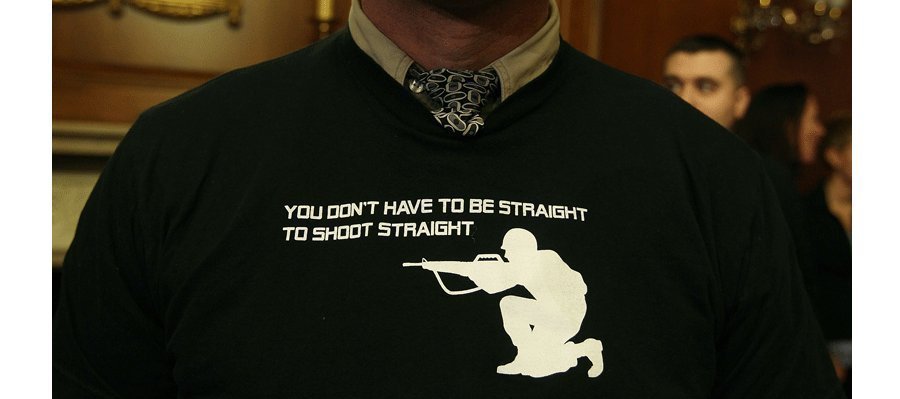
Straight Shootersby Warren

Amidst a mass of young men, I file off the cheap Oklahoman charter bus and into the void of night.  It's around 2am and I've been traveling since 6am the previous morning: LAX ->DFW->LAW.  I've just stepped into a dimly lit cove of light, surrounded by low ceilings, beige walls and aluminum benches.  We all sit, for what seems like another hour or 2 in the frigid air of an early Summer morning in Lawton, OK's Fort Sill :  "The Home of the Artillery."  The Army calls this "reception."   I'd call it uncomfortable, exhausting  and probably the nicest part of Basic Training... other than the day it concluded 9 weeks later.

This was my first experience upon becoming a member of the military.  Later would come regular transportation, over the course of two months, by "Cattle Car"; also the routine hazing of soldiers (most often vocally) by Drill Sergeants but often more physically by your fellow soldiers late at night (similar to what was famously portrayed in the film Full Metal Jacket).  But more than anything, you generally spend your time avoiding confrontation and to not show weakness in any way (an excellent story about this). Sure there was the excessive drill training we had to endure, obsessive cleaning of things (weapons, toilets, chrome plated stair plates...) and generally being in a status of perpetual sweat.  It sucked.  If you haven't read up on what the now 10-week process entails check it out and know that "Boot Camp" for the Marines must suck twice as much.

Of course this is what the training is for, to make you tough but it's a trial of endurance like most will never encounter and I just couldn't imagine how much more difficult it would be if you were deemed different than everyone else.  Drill Sergeants routinely voiced missives about how "what we're doing is weeding out the weak" and thus the soldiers in their stead would take these words to heart, when on their own time they'd punish those whom during the day were shown to be weaker than the rest.  This was most always in retaliation to the Drill Sergeant punishing the entire platoon for the weakness of one or two soldiers.  This tradition became tiresome fast and while I was never subject to this sort of in fighting, I had a few moments of failure and weakness that were trying, plus I saw a number of instances where those perceived as weak were at night beaten with bars of soap, one tripped down a flight of stairs or even some who were pushed to the point of total meltdown (two trainees in my platoon were driven to the point of psychological breakdown, one finished training and the other was sent home, deemed unfit to continue).  Many others, who simply couldn't overcome what were perceived to be physical or mental weakness, left by way of the railroad track, heading North toward Oklahoma City in the middle of the night...

Now this is what it's like to be a straight, white male in the Army's Basic Training.  What would it be like to be an effeminately gay black man in Basic Training?  There was one such young soldier who fit this description during the course of my initial training and he went by the name "Peaches."  At one time I may have known his last name, but I never officially met him nor talked to him because he was in a different platoon, so I don't know if he finished Basic Training, nor whether he continued on into regular active service.  I like to think that he did because I just can't fathom what his experience must have been after being treated unfairly would hope he was able to overcome it.  From what I could tell, surprisingly enough, he was almost treated like a rock star amongst his cohorts, yet there was this underlying derision that I could more feel, than hear.  He, like any instance that dealt with a circumstance or one deemed gay, was immediately  branded as "don't ask don't tell", a phrase commonly used in jest during those relatively early days of that infamous policy, now apparently gone forever.

It's difficult to completely understand what it's like to have lived under this discriminatory military invective over the course of five years (I was "in" from 1997-2002) but I can only imagine that it couldn't have been easy.  What I can tell you is that repealing this method of suppressing personal objectivity isn't going to inflict damage upon a war-time military.  This is the greatest farce of the DADT debate, amongst others.  Take it from General Wesley Clark who evoked exactly this response two weeks ago, in essence stating that this issue, in the eyes of the military would rank in "importance as a 2 on a scale of 1 to 10."  The most important issue to a soldier in wartime is survival and trust.  Knowing your buddy is gay means little when an already established kinship, based on personal survival, is essential to everyone's continued success. It would have no serious impact and take roughly six months of implementation and training to bring the entire force up to speed with this change.  For more details on why a repeal will find success amongst our military's ranks, look no further than the minimal impact a similar repeal had on our closest ally, Great Britain, in December of 2002.

I welcome it with open arms knowing that those who oppose serving along side LGBT members, as has been made clear through the military's study on the effects of DADT on their service members,  will either have to put up and stay in the service or shut up and leave if this wasn't what they signed on for.  That's fine and if necessary, give them honorable discharges for their service, I'd just rather not see the military sweep these feeling under the rug, enabling discrimination to continue in secret or in training, where the oppressed minds of soldiers are told not to divulge the details of their trials.  More importantly, if it takes purging 100's of soldiers who disagree, it should only make the military stronger, yet still keep the scales imbalanced after the discharge of 13,425 presumed LGBT soldiers, through 2009.

With or without DADT in place, those soldiers who want to serve their country are going to do it whether they are of a different ilk or not, for it is our diversity that makes America strong, not individual attitudes.  Conversely, these heroes personify the definition of patriotism: to know the difficult tumult you're about to self-inflict upon your own personal constitution and to do it in the face of scrutiny.  I can't think of any persons more apt to deal with conflict than those who have been tested time and time again, even by those whom they'd consider their peers and mentors.  These service members make the trials of my short military experience pale in comparison and I'm now even more beholden to their sacrifices, as I'd hope all others would be.  Yet from here forward, all soldiers will be judged by the same criterion; gone are the dark clouds of suspicion, leaving only the specter of the deliberately intended trials asked of all whom don a uniform, in ready sacrifice of the freedoms we all enjoy.  They now enjoy this freedom too.

read more by Warren at his blog, Auspicious Scuttlebutt.

Monday, December 06, 2010

What's a Boy to Do?

by Kristi 

This is one of those times when I’m looking to all of you out there to help me with a problem over the word “faggot.” I’ve run out of sage advice to give my eleven-year-old son, who has hit a life-altering stalemate over this word. I thought perhaps there may be some silver-bullet solution that I’ve missed. As a mother, I cling to the ridiculous idea that there is a solution out there, even though over 21 years of motherhood has taught me dozens of times that believing there’s an answer, is often a delusion. No, this is not directly about bullying, it’s more about friendship, family, and loyalty. Obviously, you need to know more.

My youngest son, who I’ll call “Joe” to protect his anonymity, has two best friends. One of them, “Alex,” lives only two houses away, which means if they’re both home at the same time, they’re together. Even to our extended family, Alex is not considered “company” anymore. If we’re going out to lunch, it’s not a question of if Alex will come too, it’s if “the boys” are coming, because no thought is ever given to them voluntarily separating…even for lunch. In most ways, they are regular eleven-year-old kids who just enjoy each other’s company. They play football in the yard, basketball in the driveway, video games, computer games, build Lego towns, they look at Selena Gomez pictures on the internet because she’s beautiful, they run outside if a fire truck, cop or ambulance goes by with its sirens on, they burn leaves with a magnifying glass, and they fart on each other. The only time they don’t play together is when they can’t because of schedules imposed by adults. All that changed last week. Feeling like he had no other choice, my son stood up and walked out of his best friend’s house, saying, “That’s it, I’m leaving,” because yet again, the word "faggot" was used as a weapon.

Keep this in context. A young boy saying that he will not go to his best friend’s house is a big fucking deal, a really big fucking deal. His best friend, Alex, is not using the word faggot, Alex’s 13 year old big brother is, and this is, above all things, a brother issue. My oldest son, Joe’s big brother, is gay. In a recent autobiography Joe had to write for his first week of 5th grade, he indicated that the person he admired most in the world was his sober, gay, 21 year-old big brother.

Joe has done and said everything he has in his eleven year old arsenal to stop the use of the word faggot. He explained why using the word faggot is offensive. He explained why it’s personally offensive to him. He explained that it’s not just offensive, it’s hurtful. He’s asked that the word just not be used when he’s around. None of this has curtailed the use of the word in his presence. Important note: yes, the word is used with the full knowledge and in continuous witness of the boys’ father. This is Oklahoma, so in more than half the homes down here, it would not be considered an obscenity, or something to be reprimanded for. If the kid is allowed to tease his sibling with the word dork, or idiot, then the word faggot is likely, equally acceptable.

The main thing Joe’s father and I have tried to get him to understand, is what his limits are. The main one being, he can’t make other people change. He can only know that he did everything possible to try and create a change. Sometimes, you have to find peace in knowing that you did your very best, but the rest is not up to you. We’ve told him that nobody, not even his big brother, expects him to give up going to his best friend’s house. Hanging out there is not a betrayal of his brother, or condoning what Alex’s brother says.

He’s at a “wait and see” point right now. He’s hopeful that the walk-out worked. After all, it did put an abrupt end to a really fun game. Joe was particularly happy with what he heard as he was walking out the door. He could hear Alex screaming at his big brother, “LOOK WHAT YOU DID! THAT’S MY BEST FRIEND AND THE ONLY FRIEND YOU STILL HAVE, AND YOU RUINED IT!” Interesting news, but I’m not really shocked that this young man doesn't have anyone who will still play with him except his little brother’s best friend. Unfortunately, I think the fact that he’s friendless probably illustrates this kid’s inability to consider others at all.

So, I’m wide open to hearing your ideas, or suggestions, just in case I missed some little known tool in dealing with a semi-sociopathic, Baptist, bigoted, redneck, preteen who is allowed to get away with damn near everything.

Saturday, July 31, 2010

The invisibility of bisexual men

Stephanie Chen of CNN News discusses The Last Person Out of the Closet: The Bisexual Male. She talks with Robert Winn, a bisexual man who is married to a woman, about his struggles with coming out:
This may sound like the best of both worlds, but being openly bisexual can be complicated. He frequently battles the stereotypes of bisexuality: That bisexual men are promiscuous. That his relationships with men were just an adolescent phase. That his bisexuality is imaginary. That he's really a gay man trying to camouflage his orientation.

"There is a whole list of assumptions of what my life might be like, that somehow she is some sort of front for me because I'm not willing to accept I'm gay," he said. "People are confused by bisexuality. There's just not a lot of support for people who fall in the middle like me."
His wife Christine, while supportive, does manage to compare her husband's bisexuality to an annoying behavior she must deal with:
"I don't think about it [his bisexuality] as a part I have to accept," she said. "It's just a part of him like any other husband who loses their socks on the floor or doesn't take the trash out."
I tend to come to the conclusion that the reason why it is more difficult for bisexual men to come out than for bisexual women can be attributed to females performing bisexuality for men, and the seemingly default homophobia that is socialized into Western men from birth. As Chen says:
Some say that coming out as bisexual has been easier for women than men. In recent years, several Hollywood female stars have proudly declared their bisexuality. Female celebrities like Lady Gaga, Lindsay Lohan and HBO "True Blood" actress Anna Paquin have said they are bisexual.
"It's [female bisexuality] something that's tolerated because sometimes men see it as entertaining and exciting for them," said Denise Penn, director of the American Institute of Bisexuality.
Christine Winn has felt a lot of struggles in the marriage as a result of her husband's out bisexuality, like feeling "ostracized by the gay community" because Winn's physician peers and the people within the GLBT community that he worked with assumed he was partnered with a man. Robert sums up why he ultimately decided to come out to his wife early on:
"I didn't want to turn 40, and then come out to my wife about it," he said. "I wanted to be open with her about who I am and what I think. Thankfully, she was willing to accept me."
(emphasis mine)

They are a couple of decades older than I am, I suppose, but I'm really rather taken aback by the gratitude Robert feels in her acceptance-- especially since she described her relationship to her husband's sexuality to be like her reaction to his bad habits. I simply can't imagine being upset with a spouse being bisexual. If Jesse were to tell me tonight that he's gay? Yeah, that would upset me, for obvious reasons: my husband would have just told me that he isn't attracted to me physically, and in addition to that, I'd feel hurt and confused at the secrecy and deception involved in maintaining a romantic and sexual relationship with me.

Bisexual, though? What would I have to worry about? If you're either male or female, then your bisexual partner isn't telling you that he or she isn't attracted to people of your gender. I don't see any issues beyond that. I used to wonder if maybe there would be more opportunities to cheat on your partner with no longer eliminating one half of the population by default, but then quickly realized that was based on the myth that bisexual people are promiscuous or always non-monogamous. One's sexuality doesn't determine whether or not someone will be faithful in a monogamous relationship.

I'm pleased the story has made it to a mainstream news outlet such as CNN; I am, however, disappointed in the cautious and apologetic tone of the content, as it continues to marginalize and "other" non-heterosexual people and couples.

Thursday, February 11, 2010

Alan Touring

I just wanted to link to an interesting post I stumbled across in some of my internet technical wondering:

http://numberedhumanindustries.wordpress.com/2010/02/11/ending-%E2%80%9Cdon%E2%80%99t-ask-don%E2%80%99t-tell%E2%80%9D/

The post itself is worthwhile, its also inspired me to research contemporary and historical GLBT figures outside of the humanities and arts. Any recommendations?

N

Wednesday, November 18, 2009

Let's talk about gay marriage

Photobucket

...I mean, why not?

when I consider what I want to write about in a blog post, I never consider my options to include gay marriage, abortion, or the death penalty (the Big Three), because... well, everyone has already made every argument known to humankind for or against all of them. We've all heard it, we've all chosen a "side." They're all tired subjects these days, when it comes to social commentary. But, who cares. Today, I'm thinking about gay marriage. It's on my mind, so I shall write:

Why does anyone oppose the idea of two men or two women getting married to one another? The only opponents thus far seem to be opposed for religious reasons. If one is concerned that gay marriage would oppose their religious beliefs, then there is a really reasonable solution to that: if you're a heterosexual religious person, then simply don't elect to marry a person of the same sex. If you're a religious official, do not elect to marry gay couples. I'm fairly certain that there's some part of our Constitution that says something along the lines of "freedom of religion" or something like that.

All right, sarcasm aside, the part of the First Amendment that discusses religion says:

Congress shall make no law respecting an establishment of religion, or prohibiting the free exercise thereof;


Which means that Congress cannot establish or maintain a religious structure to dictate the laws and lives of US citizens, and/because as US citizens, we all have the right to religious freedom and expression as we see fit. No religion shall be considered dominant or influential in our law making, and no law shall be passed that prohibits or discourages people from expressing their religious beliefs.

Now, luckily for Christians in the US, church officials are legally allowed to perform marriages. This means that you can go to the county government office like your atheist or agnostic friends, get your marriage license, and have your priest, pastor, imam, or whomever, perform the marriage, and it becomes official, according to secular US law. Luckily for non-Christian or non-religious people, there is also the option of a Justice of the Peace or otherwise secularly ordained officiant to legally marry you. In fact, it's really astonishingly easy to become legally allowed to marry people.

What I understand is that a Christian person may feel that a gay couple being married is a sin in the eyes of their god. This is understandable, and not something I'm interested in arguing about with someone who is religious. I'm not trying to debunk anyone's (usually) harmless belief systems. However, if one is married by a religious official, the marriage is blessed by God, and therefore a holy matrimony. If your local justice of the peace marries two women tomorrow afternoon, well, what does that have to do with anything? If it were a heterosexual couple being married by a JOP, you wouldn't consider it to be a holy matrimony, either, right? That would presumably be because a JOP isn't giving God's blessing to your marriage. A JOP is simply making a domestic partnership into a legally binding contract. Where are the objections to heterosexual couples being married by secular institutions? I have heard of absolutely zero complaints about non-religious heterosexual couples being married by a judge, or their rights as married people.

What I truly don't understand is why a heterosexual Christian person would find a gay marriage threatening. It doesn't change the meaning of their marriage in the eyes of God.

If heterosexual religious people object to gay marriage within their church or religious institutions, then I say, more power to them. Have at it. Discriminate all you want. Why? Because your religious beliefs don't have an effect on the secular lives of those around you. At least, they shouldn't. Likewise, allowing homosexual people to marry someone of the same sex has no impact on religious people.

I understand the implications of saying that I believe that religious institutions have the right to be discriminatory in their allowance of certain ceremonial events. It would be discriminating against gay Christians, for one. But... well, if I don't want someone's religion to dictate my life, then I'm also not willing to demand that secular practices dictate the lives of religious people in a way that undermines or negates their religious beliefs. So, men can marry men and women can marry women legally, and Christian churches (and other non-Christian religions) can decide who they want to marry under the guidelines of their religion. Seems simple enough, right? They can all be legal under US law, so... what's the problem again?

Furthermore, is there anyone out there who is not religious, Christian or otherwise, who believes that gay people should not have the right to marry a person of the same sex? I haven't heard of any.

It seems so utterly simplistic, and I can't wrap my mind around what the actual problem is. The religious right seems to think that their interpretation of what certain people said that their god said should be universal law, but that's obviously incorrect in the context of our legal system and the founding of our nation, so where is the disconnect? Why are we stalling a civil rights issue over a group's beliefs, when the solution is to simply... you know, continue separating church and state?

Wednesday, November 11, 2009

So does that make me straight curious as well?

Hey folks this is Danny (aka sanguinedream) from Danny's Corner and I've been invited to become a contributor here and I just could not refuse.

Since Cacophonies seems to be up for a wide range of topics I'm gonna go left field for a bit and talk about sexuality for my introduction.

I'm sure you are more than likely familiar with the term "bi-curious" right? If not it refers to one is generally identifies as heterosexual or homosexual but has curiosities about romantic or sexual activities with people of the same (if you're heterosexual) or opposite (if you're homosexual) gender. So to be curious about romance or sex of the orientation opposite of what you identify with there is the implication that you have never done such things before. So what if you have no sexual or romantic experience?

I've called myself heterosexual for the vast majority of my life. Checking women out. Paying attention to women in porn (but not lesbian porn but that is another story for another day). Fantasizing about women. Par for the course for a heterosexual man (or homosexual woman) right? However about five years ago I opened up to thoughts about homosexuality. Checking men out. Paying attention to men in porn. Fantasizing about men. Par for the course for a homosexual men (or heterosexual woman) right?

Thing is I have no experience in either one.

So based on the fact that I have no experience in heterosexual or homosexual romance/sex does that mean that I'm in some weird limbo in which I'm straight curious and gay curious at the same time? Or can I just call it simply curious since without any experience I'm still at the starting point of discovering my sexuality? Just wondering.